
I have outdoor cats, and when you have cats that you feed outdoors, you frequently end up with possums that come and eat your cat food (as well as the occasional deer). Tonight I was watching tv when I heard a clattering on the front porch. The cats are quiet when they are eating their cat food, so a clattering means possums. I don't like possums hanging around my house, so when I hear clattering on the porch, I grab my quarterstaff, open the door and chase the possums off.
Well tonight when I opened the door, instead of seeing a possum, I saw a skunk. With his tail raised and pointed right at me. I slammed the door.
I waited a moment then cracked the door and peeked out. No skunk. I carefully opened the door further and took a good look around. My black cat, Bastet, came walking toward me with an innocent look on her face. But now I know better. She's apparently been having assignations with Pepe Le Pew on my front porch.
Saturday, July 2, 2011


Saturday, June 18, 2011
A Peek at Lysts on the Lake 2011
Here is a short video showing what I was so involved with that I didn't have time to post. I think you will agree that helping out with a modern competitive jousting tournament is more exciting than sitting in front of your computer and writing blog posts. Not that I don't enjoy writing blog posts, but come on --- It's real live jousting! With real live knights in shining armor! Riding real live horses!
Doesn't that look like fun?
Doesn't that look like fun?
Monday, June 13, 2011
Electric Needles
Sorry for the long hiatus. I got all caught up in preparations for Lysts on the Lake, then working as staff for Lysts, then recovering from Lysts, and then just sort of being out of the habit of writing. I'll try to do better in the future.
Anyway... A while back my butt was healed enough that I was able to start doing sit ups again. I had to do them on the thickest softest carpet in the house, and I couldn't do many of them because it still hurt. And, of course, I was horribly out of shape. Over the past year, I'd gained almost 20 pounds and lost most of my muscle tone and flexibility. It seems like just laying on the couch reading and watching tv all day leads to flabbiness and obesity. I had begun to really hate my body. I've been physically active all of my life and I had been one of those few women who were actually quite happy with their bodies, until this accident happened. So, as soon as it wasn't actually painful to exercise, I started doing sit ups again. I'd tried walking on the treadmill, but that was actually quite uncomfortable. (I now know why it hurt, but didn't understand at the time.) So I just stuck to doing sit ups.
When I first started doing the sit ups, my tailbone was still so sensitive that I sort of did them off center. I was basically putting almost all my weight on my left hip so that there wasn't as much pressure on my tailbone. Naturally, this led to my sit ups being somewhat lopsided. I didn't care. I was exercising again. And it was helping me to feel better about myself even if I really wasn't doing that much. However, as my tailbone became less sensitive, I tried to start doing more balanced sit ups and I noticed that something was seriously wrong.
When I actually distributed my weight evenly between both hips, and did a sit up, as I was in the sitting up position, my right knee was NOTICEABLY higher than my left knee. At first I thought that because I was in the habit of sitting on my left hip, that I was simply not actually distributing my weight evenly. But after several attempts to redistribute my weight evenly so as to even my knees out, I realized that I was actually sitting evenly on both hips, and there was simply something wrong with my right hip that was forcing my right knee up higher. I sort of freaked a little. I wondered if I had actually broken my hip in some way, and that it had healed all wrong and now I was going to have the live the rest of my life with a mangled hip. I kept trying to re-assure myself that there was no way, no matter how good I am at ignoring pain, that I could have been walking around all this time with a broken hip. But I also kept remembering how much trouble I did have walking at first, and how my right leg at times simply refused to do what I told it to.
My husband and DA did their best to re-assure me and I set up a doctor's appointment as soon as possible. My doctor examined me and agreed that there was definitely something wrong with my hip, but that he wasn't sure exactly what it was. He wanted to do an MRI, but we only have catastrophic insurance with a $3000 deductible, so we really couldn't afford that. So we did a series of simple x-rays which reassured me that nothing other than my tailbone was broken. The problem was obviously in the muscles. My doctor then sent me to a specialist/physical therapist to try and figure out exactly what was wrong with my muscles. Turns out that my muscles had been so traumatized by the fall that they basically knotted up and then became so inflamed (swollen) that they couldn't unknot. The muscles in my right buttock and thigh had been continuously flexed for over a year. And what happens when you repeatedly (continuously) flex a muscle? It gets bigger. I now have one ginormous butt muscle.
Even the physical therapist wasn't quite sure what to do to try and fix things. He asked me to do some stretches and things, but I still had enough left over flexibility that the stretches didn't have the least effect on loosening up my poor butt. He decided to try poking it with electric needles. He wasn't sure that would work because the electric needles are actually used to cause the muscles to contract, but he thought that if we made the muscles contract even more, then, when we turned the electric needles off, the muscles might actually relax.
He didn't use the electric needles during my first visit, he just did some heat treatments and sent me home. He wanted to do some research and think about things before actually trying the electric needles. On my second visit, he first had me do some exercises that dealt with balance and theoretically worked the affected muscles in some beneficial way. Then he took me behind a privacy curtain and had me lay face down on a table. He then proceeded to stick a bunch of acupuncture type needles into various places on both buttocks. Though he did place more in my right buttock than my left. The needles were hooked to an electric current somehow. I really couldn't see much from my position. And he turned the electricity on. He adjusted the current by asking me when it was just on the edge of painful. Then he left the electric needles to do their thing for about 10 minutes.
After it was over, my butt was pretty sore for the rest of that day and somewhat sore the next, but on the third day, it actually seemed like it had helped. Of course, ever since I found out that the problem was overly tense butt muscles, I'd been trying to consciously relax my butt and that may have been helping as well. Because of my dance, meditation and martial arts background, I am actually pretty good at making my muscles relax on demand. However, I'd never really focused on my butt muscles before.
Anyway, over the next few weeks, my butt did seem to feel better. I could sit for longer periods of time before it became too painful. And in general, my body was beginning to feel better. I added push ups and squats to my exercise routine and I can now walk on the treadmill even though I still have to be careful with that, and if I feel my butt muscles tensing up, I stop. My body is finally beginning to trim down a little, although I am still pretty unhappy whenever I look in a mirror. But I will keep exercising and sooner or later, I'll get a healthy body back. However, my right buttock will probably always be bigger than my left. (And yes, having uneven buttocks definitely affects my riding. More about that in the next post.)
I really should go back and get another treatment with the electric needles. I'm sure it would help. I just have to make the time.
And next time I get injured, I'm going to a doctor right away. I promise.
Saturday, April 16, 2011
How Do You Rate Your Pain?
Yeah, I've been getting that question a lot as I've been seeing doctors and physical therapists who are still trying to fix me from my fall. It's not an easy question to answer.
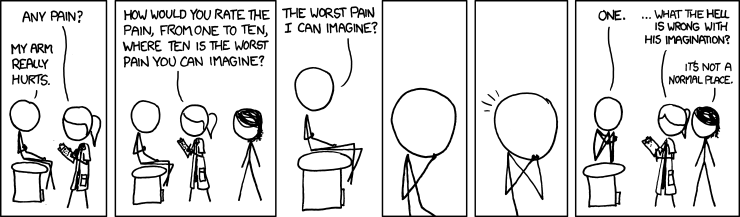
Make sure you go to the XKCD site so you can read the mouse-over text. (Drag your mouse over the comic and a little rectangle with text should show up. If it doesn't show up at first, drag your mouse way off to the side then bring it back over the comic and stop.)
Tuesday, April 12, 2011
Three Horses Die During England's Grand National 2011
All sports are dangerous to some extent. Equestrian sports are more dangerous than most, both to the rider and to the horse. Occasionally, riders and horses die. This is sad, but true. But consider, the rider chooses to compete. The horse has no choice in the matter. It is up to the riders and others involved in the sport to make it as safe as possible for the horses while still maintaining the spirit of the event. Of course, the only way to completely prevent the death of horses in equestrian events is to completely stop equestrian events. That seems a bit extreme. However, when an event has proven to be excessively dangerous to horses, it needs to be changed or stopped.
Over the past 11 years, 33 horses have died competing in England's Grand National which is held at Aintree Race Course, one of the most famously brutal racing tracks in the world. Surprisingly, there has been only one recorded human fatality in the event's history (Joe Wynne in 1862), though that may change if jockey Peter Toole, who was critically injured this year, fails to recover. The final race, John Smith's Grand National Chase, is four and a half miles long and the horses are supposed to jump all but two of Aintree's 16 steeplechase jumps twice, making for 30 jumps total. (Aintree Course guide) During this year's Grand National, which ran from April 7 – 9, 2011, three horses died. Two of the three died in the final race.
Below is a list of the horses that have died during or because of injuries sustained during the three days of the Grand National each of the past 11 years:
2000 – Strong Promise, Rossell Island, Architect, Lake Kariba and Toni's Tip
2001 – Outback Way
2002 – Last Fling, Manx Magic, Desert Mountain and Anubis Quercus
2003 – Goguenard and Coolnagorna
2004 – no deaths
2005 – Lilium de Cotte
2006 – Terivic and Tyneandthyneagain
2007 – Lord Rodney, Into the Shadows and Graphic Approach
2008 – Time to Sell, The High Grass and McKelvey
2009 – Hear the Echo, Exotic Dancer, Mel In Blue, Moscow Catch and Lilla Sophia
2010 – Pagan Starprincess, Prudent Honour, Plaisir D'Estraval and Schindlers Hunt
2011 – Ornais, Dooneys Gate and Inventor
That's an average of 3 fatalities a year. With only one year with no fatalities. That certainly seems like the event is excessively dangerous to horses.
Generally, fewer than half of those who compete in the John Smith's Grand National even make it to the finish line. The record for the most horses to finish the race was 23 in 1984. In 1929, only 2 horses were able to complete the course. In this year's race, out of 40 horses who started the event, 19 completed it. Ten horses fell, of which two died, two more were tripped by fallen horses, four unseated their riders and five were pulled up for various reasons. The fact that consistently less than half the horses who start the race even finish it, is yet another reason to re-examine the way this particular race is run.
Admittedly, some changes have been made to try and make the Grand National safer. The drops on the landing side of some jumps have been reduced. However, even though the brook at the infamous Becher's Brook fence was filled in, it is still a 4' 10” jump from the front with a 6' 9” drop on the back. In 2009, a bypass area was created around certain jumps, including the infamous Becher's Brook. Two of these bypass areas had to be used this year in order to avoid running over the dead horses still lying beside the jumps after the first circuit of the track.
Strangely, veteran trainer, Ginger McCain, who won the Grand National race three times with horse Red Rum, blames the safety improvements for causing the deaths of the horses. "It’s getting quicker and it’s speed that does it… They’ve taken the drops out for the do-gooders and it has encouraged the horses to go quicker. It is speed that kills." Considering the winner of the race, Jason Maguire riding Ballabriggs, was given a five day ban for excessive use of his whip, I don't think it's the do-gooders who are making the horses go quicker. (Maguire has been banned for excessive whip use before, and at least one ban was recently overturned in order to allow him to race.)
Also, if you actually look at the race times over the past 11 years and more, the race times have NOT consistently gone down. Although this years winning time of 9min 1.2sec is the second fastest recorded time following the record set in 1990 of 8min 47.8sec(According to most articles, that is. It looks to me like it's the third fastest time, since Rough Quest finished in 9min 0.8sec in 1996. Anyway...), winning times over the past years have varied upwards and downwards with no consistent pattern. And if you look at winning time vs number of fatalities, there is no correlation between speed of the race and number of deaths. In the past 11 years, the only year (2004) with no deaths had a winning time of 9min 20.3sec and the year(2009) with the most horse deaths (5) had a winning time of 9min 32.9sec. The changes made to the course have not made it noticeably faster. Unfortunately, they do not seem to have made it any safer either.
The race is simply too grueling. Even horses that don't die from falls, sometimes collapse from being pushed too hard. After winning this years race, Ballabriggs was considered too exhausted to enter the winner's circle and had to be given oxygen to help him recover. In fact, three out of the first four horses to finish had to be immediately treated for exhaustion and were unable to appear in the winner's enclosure. Fortunately, they all seem to have recovered. Unlike other horses which have died of heart attacks during or immediately after the races. Somehow, I don't think those horses have willingly run themselves to death.
However, some participants claim to believe that the horses enjoy the race. Donald McCain, son of Ginger McCain, and trainer of Ballabriggs, is quoted as saying,”If it [the horse] does not want to jump at Aintree, he won't jump.” According to that logic, ill-trained, ill-tempered, nonathletic horses who refuse jumps or dump their rider, are simply expressing their belief that equestrian sports are inherently too dangerous for them to participate in. And well-trained, willing, athletic horses who behave properly, apparently understand the danger and have consented to risk their lives in the name of spectacle. I find that type of “logic” hard to believe.
Horses, although extraordinary animals, are not capable of understanding the danger of certain equestrian sports and cannot choose for themselves whether that danger is acceptable. It is up to those of us who truly care for the well-being of horses to mitigate the risks of racing and other horse sports. Admittedly, there is no way to remove all risk from equestrian sports, but when an event such as the Grand National has proven to be excessively dangerous for horses, something needs to be done.
The question is... what is excessively dangerous? Well, for comparison, the Omak Stampede and World Famous Suicide Race, which openly claims to be the most dangerous horse race in the world, had 15 officially recorded horse fatalities during the actual race between 1984 and 2006. Unfortunately, there is no official record of how many horses died or had to be put down after the race because of injuries sustained during the race. Unofficially, it is reported that apx 21 horses have died because of the race during the past 26 years. Even using the higher unofficial count, that's less than one horse fatality per year, compared to the Grand National's 33 horse fatalities in the past 11 years which averages out to 3 horse fatalities per year. I am not saying that I approve of the Omak Suicide Race, I very definitely do not. But compared to England's Grand National, it appears to be less dangerous for the horses forced to compete.
For those of you unfamiliar with the Omak Suicide Race. It is a race consisting of a galloping start leading quickly to a plunge down a 62 degree dirt slope that's 225 feet long and narrows as it goes down. The slope drops into a 100 yard wide river that the horse must swim across and then climb up a more gradual incline to a 500 yard sprint to the finish line. This race is run by the same horse three days in a row. The first two runs are done in the dark of night. It is considered by many to be an appalling abuse of horses simply for commercial gain. It is NOT as some people have claimed, a traditional rite of passage for Native American tribesmen. It was created by a local businessman purely as a financial endeavor. Local tribes agreed to participate in order to receive part of the profits. The United States Humane Society published a video denouncing the race in 2006.
The Omak Suicide Race is a fairly small and relatively unknown event compared to England's Grand National, but it has been widely denounced in the US and in other countries. The final race of the Grand National is one of the biggest and most popular races in the world. It is major national event in England. This year's live televised broadcast of the final race was seen by 8.8 million viewers on BBC 1 during the 15 minutes between 4:15 and 4:30pm alone. The estimated worldwide audience for footage of the John Smith's Grand National Chase is apx 600 million people in 140 countries. How can something that is so well-known and widely watched be allowed to continue to be so excessively dangerous to horses? Yes, there has been and continues to be some public outcry against the deaths of horses for public entertainment. But very little has actually been done. And what little has been done, has not improved the survival rate of the horses made to compete.
I would not have been surprised to have discovered such a brutal race being celebrated in a third world country where animal welfare is not much of a concern. But frankly I was shocked to discover that such a deadly race is not only allowed to continue, but is celebrated as part of the national culture of England.
http://www.dailymail.co.uk/news/article-1375210/Grand-National-2011-Ballabriggs-wins-day-drama-Aintree.html (Warning: Graphic pictures)
http://www.dailymail.co.uk/news/article-1375569/Grand-National-2011-Do-gooders-safety-row-jockey-lies-coma-horses-die.html (Warning: Graphic pictures)
http://www.dailymail.co.uk/sport/racing/article-1375310/Grand-National-2011-Aintree-day-horror-millions-2-horses-die.html?ito=feeds-newsxml (Warning: Graphic pictures)
http://www.guardian.co.uk/sport/2011/apr/09/grand-national-2011-two-deaths
http://www.mauritiushot.com/video-two-horses-die-at-grand-national-2011/
http://www.guardian.co.uk/sport/blog/2011/apr/09/grand-national-2011-live
http://www.horsechannel.com/horse-news/2011/04/12/grand-national-steeplechase-fatalities.aspx
http://www.bbc.co.uk/liverpool/content/image_galleries/grand_national_09_historic_gallery.shtml?2
http://www.aintree.co.uk/
http://www.aintree.co.uk/grandnationalwinners
http://www.aintree.co.uk/pages/broadcasting-of-the-grand-national/
http://www.bellaonline.com/articles/art42064.asp
http://www.guardian.co.uk/sport/2011/apr/10/grand-national-bullfighting-deaths (Warning: Graphic picture)
http://en.wikipedia.org/wiki/Grand_National
http://news.bbc.co.uk/sport2/hi/other_sports/horse_racing/9406041.stm
http://www.guardian.co.uk/media/2011/apr/11/grand-national-tv-ratings
Aintree course guide: http://news.bbc.co.uk/sol/shared/spl/hi/horse_racing/05/grandnational/html/default.stm
1967 video: http://www.youtube.com/watch?v=T0n--QhZQgI
2011 video: http://www.youtube.com/watch?v=GllKThibSLo
http://www.paws.org/omak-suicide-race-faq.html
http://ida.convio.net/site/MessageViewer?em_id=5701.0
http://www.omakstampede.org/
http://en.wikipedia.org/wiki/Suicide_Race
http://www.paws.org/archives/PeopleHelpingAnimals/mainnews2005_06_05.htm
http://usesr.org/Omak-Suicide-Race.html
Humane Society video about the Omak Suicide Race: http://www.youtube.com/watch?v=_4pig67unHo
http://fuglyblog.com/?p=2776
Over the past 11 years, 33 horses have died competing in England's Grand National which is held at Aintree Race Course, one of the most famously brutal racing tracks in the world. Surprisingly, there has been only one recorded human fatality in the event's history (Joe Wynne in 1862), though that may change if jockey Peter Toole, who was critically injured this year, fails to recover. The final race, John Smith's Grand National Chase, is four and a half miles long and the horses are supposed to jump all but two of Aintree's 16 steeplechase jumps twice, making for 30 jumps total. (Aintree Course guide) During this year's Grand National, which ran from April 7 – 9, 2011, three horses died. Two of the three died in the final race.
Below is a list of the horses that have died during or because of injuries sustained during the three days of the Grand National each of the past 11 years:
2000 – Strong Promise, Rossell Island, Architect, Lake Kariba and Toni's Tip
2001 – Outback Way
2002 – Last Fling, Manx Magic, Desert Mountain and Anubis Quercus
2003 – Goguenard and Coolnagorna
2004 – no deaths
2005 – Lilium de Cotte
2006 – Terivic and Tyneandthyneagain
2007 – Lord Rodney, Into the Shadows and Graphic Approach
2008 – Time to Sell, The High Grass and McKelvey
2009 – Hear the Echo, Exotic Dancer, Mel In Blue, Moscow Catch and Lilla Sophia
2010 – Pagan Starprincess, Prudent Honour, Plaisir D'Estraval and Schindlers Hunt
2011 – Ornais, Dooneys Gate and Inventor
That's an average of 3 fatalities a year. With only one year with no fatalities. That certainly seems like the event is excessively dangerous to horses.
Generally, fewer than half of those who compete in the John Smith's Grand National even make it to the finish line. The record for the most horses to finish the race was 23 in 1984. In 1929, only 2 horses were able to complete the course. In this year's race, out of 40 horses who started the event, 19 completed it. Ten horses fell, of which two died, two more were tripped by fallen horses, four unseated their riders and five were pulled up for various reasons. The fact that consistently less than half the horses who start the race even finish it, is yet another reason to re-examine the way this particular race is run.
Admittedly, some changes have been made to try and make the Grand National safer. The drops on the landing side of some jumps have been reduced. However, even though the brook at the infamous Becher's Brook fence was filled in, it is still a 4' 10” jump from the front with a 6' 9” drop on the back. In 2009, a bypass area was created around certain jumps, including the infamous Becher's Brook. Two of these bypass areas had to be used this year in order to avoid running over the dead horses still lying beside the jumps after the first circuit of the track.
Strangely, veteran trainer, Ginger McCain, who won the Grand National race three times with horse Red Rum, blames the safety improvements for causing the deaths of the horses. "It’s getting quicker and it’s speed that does it… They’ve taken the drops out for the do-gooders and it has encouraged the horses to go quicker. It is speed that kills." Considering the winner of the race, Jason Maguire riding Ballabriggs, was given a five day ban for excessive use of his whip, I don't think it's the do-gooders who are making the horses go quicker. (Maguire has been banned for excessive whip use before, and at least one ban was recently overturned in order to allow him to race.)
Also, if you actually look at the race times over the past 11 years and more, the race times have NOT consistently gone down. Although this years winning time of 9min 1.2sec is the second fastest recorded time following the record set in 1990 of 8min 47.8sec(According to most articles, that is. It looks to me like it's the third fastest time, since Rough Quest finished in 9min 0.8sec in 1996. Anyway...), winning times over the past years have varied upwards and downwards with no consistent pattern. And if you look at winning time vs number of fatalities, there is no correlation between speed of the race and number of deaths. In the past 11 years, the only year (2004) with no deaths had a winning time of 9min 20.3sec and the year(2009) with the most horse deaths (5) had a winning time of 9min 32.9sec. The changes made to the course have not made it noticeably faster. Unfortunately, they do not seem to have made it any safer either.
The race is simply too grueling. Even horses that don't die from falls, sometimes collapse from being pushed too hard. After winning this years race, Ballabriggs was considered too exhausted to enter the winner's circle and had to be given oxygen to help him recover. In fact, three out of the first four horses to finish had to be immediately treated for exhaustion and were unable to appear in the winner's enclosure. Fortunately, they all seem to have recovered. Unlike other horses which have died of heart attacks during or immediately after the races. Somehow, I don't think those horses have willingly run themselves to death.
However, some participants claim to believe that the horses enjoy the race. Donald McCain, son of Ginger McCain, and trainer of Ballabriggs, is quoted as saying,”If it [the horse] does not want to jump at Aintree, he won't jump.” According to that logic, ill-trained, ill-tempered, nonathletic horses who refuse jumps or dump their rider, are simply expressing their belief that equestrian sports are inherently too dangerous for them to participate in. And well-trained, willing, athletic horses who behave properly, apparently understand the danger and have consented to risk their lives in the name of spectacle. I find that type of “logic” hard to believe.
Horses, although extraordinary animals, are not capable of understanding the danger of certain equestrian sports and cannot choose for themselves whether that danger is acceptable. It is up to those of us who truly care for the well-being of horses to mitigate the risks of racing and other horse sports. Admittedly, there is no way to remove all risk from equestrian sports, but when an event such as the Grand National has proven to be excessively dangerous for horses, something needs to be done.
The question is... what is excessively dangerous? Well, for comparison, the Omak Stampede and World Famous Suicide Race, which openly claims to be the most dangerous horse race in the world, had 15 officially recorded horse fatalities during the actual race between 1984 and 2006. Unfortunately, there is no official record of how many horses died or had to be put down after the race because of injuries sustained during the race. Unofficially, it is reported that apx 21 horses have died because of the race during the past 26 years. Even using the higher unofficial count, that's less than one horse fatality per year, compared to the Grand National's 33 horse fatalities in the past 11 years which averages out to 3 horse fatalities per year. I am not saying that I approve of the Omak Suicide Race, I very definitely do not. But compared to England's Grand National, it appears to be less dangerous for the horses forced to compete.
For those of you unfamiliar with the Omak Suicide Race. It is a race consisting of a galloping start leading quickly to a plunge down a 62 degree dirt slope that's 225 feet long and narrows as it goes down. The slope drops into a 100 yard wide river that the horse must swim across and then climb up a more gradual incline to a 500 yard sprint to the finish line. This race is run by the same horse three days in a row. The first two runs are done in the dark of night. It is considered by many to be an appalling abuse of horses simply for commercial gain. It is NOT as some people have claimed, a traditional rite of passage for Native American tribesmen. It was created by a local businessman purely as a financial endeavor. Local tribes agreed to participate in order to receive part of the profits. The United States Humane Society published a video denouncing the race in 2006.
The Omak Suicide Race is a fairly small and relatively unknown event compared to England's Grand National, but it has been widely denounced in the US and in other countries. The final race of the Grand National is one of the biggest and most popular races in the world. It is major national event in England. This year's live televised broadcast of the final race was seen by 8.8 million viewers on BBC 1 during the 15 minutes between 4:15 and 4:30pm alone. The estimated worldwide audience for footage of the John Smith's Grand National Chase is apx 600 million people in 140 countries. How can something that is so well-known and widely watched be allowed to continue to be so excessively dangerous to horses? Yes, there has been and continues to be some public outcry against the deaths of horses for public entertainment. But very little has actually been done. And what little has been done, has not improved the survival rate of the horses made to compete.
I would not have been surprised to have discovered such a brutal race being celebrated in a third world country where animal welfare is not much of a concern. But frankly I was shocked to discover that such a deadly race is not only allowed to continue, but is celebrated as part of the national culture of England.
Links for information about England's Grand National:
http://www.dailymail.co.uk/news/article-1375210/Grand-National-2011-Ballabriggs-wins-day-drama-Aintree.html (Warning: Graphic pictures)
http://www.dailymail.co.uk/news/article-1375569/Grand-National-2011-Do-gooders-safety-row-jockey-lies-coma-horses-die.html (Warning: Graphic pictures)
http://www.dailymail.co.uk/sport/racing/article-1375310/Grand-National-2011-Aintree-day-horror-millions-2-horses-die.html?ito=feeds-newsxml (Warning: Graphic pictures)
http://www.guardian.co.uk/sport/2011/apr/09/grand-national-2011-two-deaths
http://www.mauritiushot.com/video-two-horses-die-at-grand-national-2011/
http://www.guardian.co.uk/sport/blog/2011/apr/09/grand-national-2011-live
http://www.horsechannel.com/horse-news/2011/04/12/grand-national-steeplechase-fatalities.aspx
http://www.bbc.co.uk/liverpool/content/image_galleries/grand_national_09_historic_gallery.shtml?2
http://www.aintree.co.uk/
http://www.aintree.co.uk/grandnationalwinners
http://www.aintree.co.uk/pages/broadcasting-of-the-grand-national/
http://www.bellaonline.com/articles/art42064.asp
http://www.guardian.co.uk/sport/2011/apr/10/grand-national-bullfighting-deaths (Warning: Graphic picture)
http://en.wikipedia.org/wiki/Grand_National
http://news.bbc.co.uk/sport2/hi/other_sports/horse_racing/9406041.stm
http://www.guardian.co.uk/media/2011/apr/11/grand-national-tv-ratings
Aintree course guide: http://news.bbc.co.uk/sol/shared/spl/hi/horse_racing/05/grandnational/html/default.stm
1967 video: http://www.youtube.com/watch?v=T0n--QhZQgI
2011 video: http://www.youtube.com/watch?v=GllKThibSLo
Links for information about the Omak Suicide Race:
http://www.paws.org/omak-suicide-race-faq.html
http://ida.convio.net/site/MessageViewer?em_id=5701.0
http://www.omakstampede.org/
http://en.wikipedia.org/wiki/Suicide_Race
http://www.paws.org/archives/PeopleHelpingAnimals/mainnews2005_06_05.htm
http://usesr.org/Omak-Suicide-Race.html
Humane Society video about the Omak Suicide Race: http://www.youtube.com/watch?v=_4pig67unHo
Another blogger comparing England's Grand National to the Omak Suicide Race
http://fuglyblog.com/?p=2776
Friday, April 1, 2011
I've Decided to Joust
Jousting just looks like so much fun that I've decided instead of just helping out with the Lysts on the Lake: Lone Star Open Joust, that I want to actually compete as a jouster.
ummm...
Yeah, right, this is an April Fool's joke. There is no way that I will be jousting at the tournament. There is no way that I will ever joust, period. There is however an actual competitive jousting tournament being held in Austin, TX from April 29 - May 1, 2011. My good friend SH is producing it, and my husband will be competing in it. It promises to be one of the largest, if not the largest competitive joust in the US. At least as far as number of jousters goes. To find out more about the Lysts on the Lake, just click on the link.
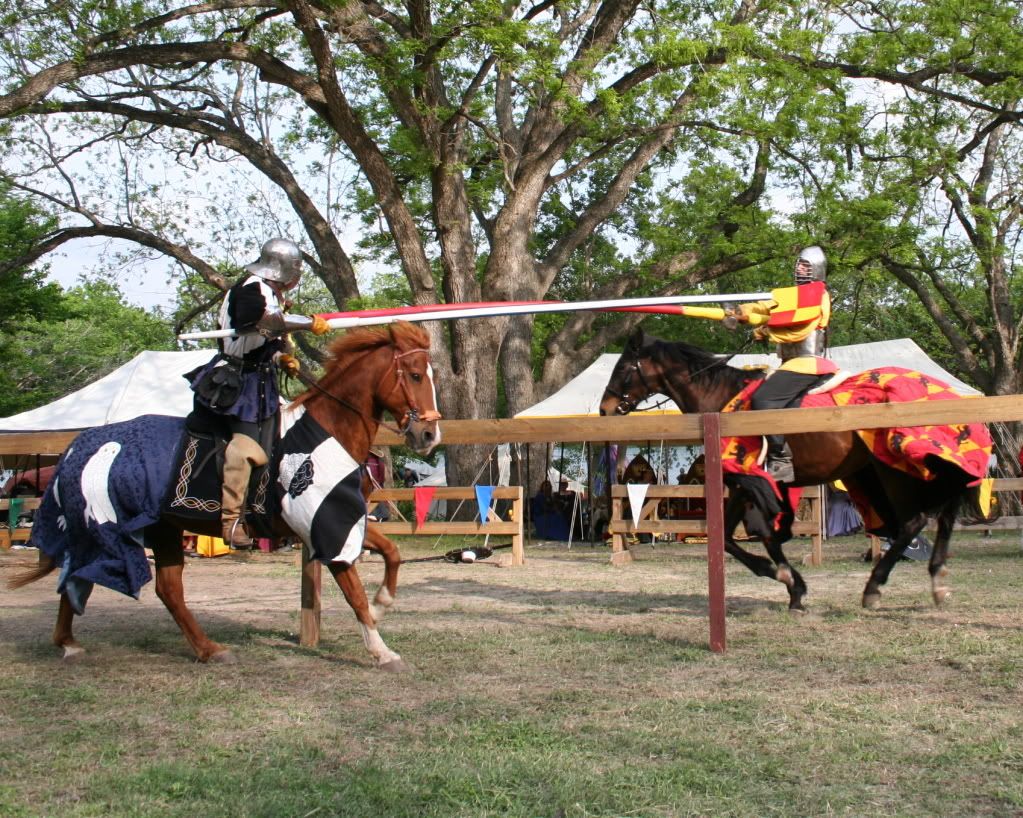
My friend SH on his trusty steed Lucky(on left) tilting against another friend at a previous tournament
ummm...
Yeah, right, this is an April Fool's joke. There is no way that I will be jousting at the tournament. There is no way that I will ever joust, period. There is however an actual competitive jousting tournament being held in Austin, TX from April 29 - May 1, 2011. My good friend SH is producing it, and my husband will be competing in it. It promises to be one of the largest, if not the largest competitive joust in the US. At least as far as number of jousters goes. To find out more about the Lysts on the Lake, just click on the link.
My friend SH on his trusty steed Lucky(on left) tilting against another friend at a previous tournament
Wednesday, March 30, 2011
Roadside assistance for those hauling horses
Another blogger I read mentioned how useful she has found US RIDER. A roadside assistance service for people who haul horses. I've never tried it myself since we don't have a truck capable of hauling a horse trailer, but it seems like a useful service. So I thought that I would mention it in my blog in case someone else might find it useful.
Subscribe to:
Posts (Atom)


